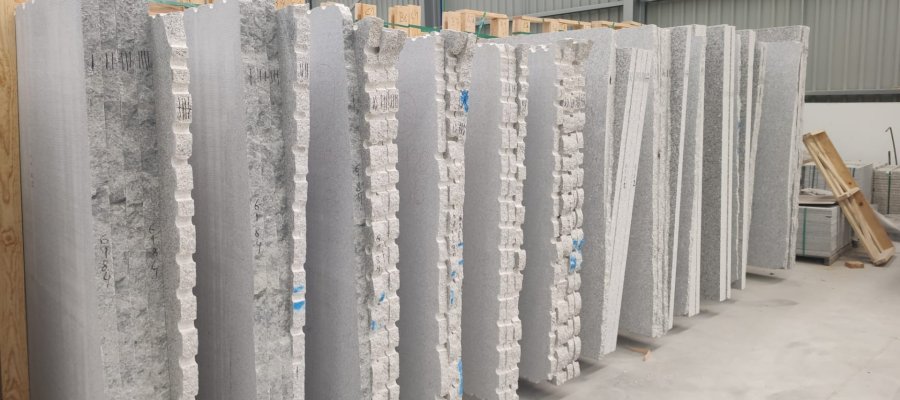
Whether for internal use or direct commercialization, stone slab production follows strict quality requirements aimed at creating a technically precise and consistent product.
The selection of blocks intended for slab production is based on technical and operational criteria such as stone type, structural integrity, block dimensions, required thickness, and intended use.
During the sawing process, blocks are cut into slabs with controlled thickness. Our installed industrial capacity allows us to process large-scale blocks, often exceeding 180 cm in height, in optimized production cycles, ensuring dimensional consistency and repeatability across high volumes.
After sawing, the slabs proceed to the application of the required surface finish on one face. At this stage, treatments are applied that define the final appearance and functional behavior of the material. Smooth finishes such as polished, honed, or leather can be applied, as well as rougher finishes such as flamed or shot-blasted, suitable for applications with specific slip-resistance or grip requirements.
Once these operations are completed, the slabs are ready to integrate different stages of the value chain. They may proceed to internal fabrication processes, where they will be transformed into finished pieces, or be prepared for shipment as an intermediate product, destined for distributors and specialized operators.
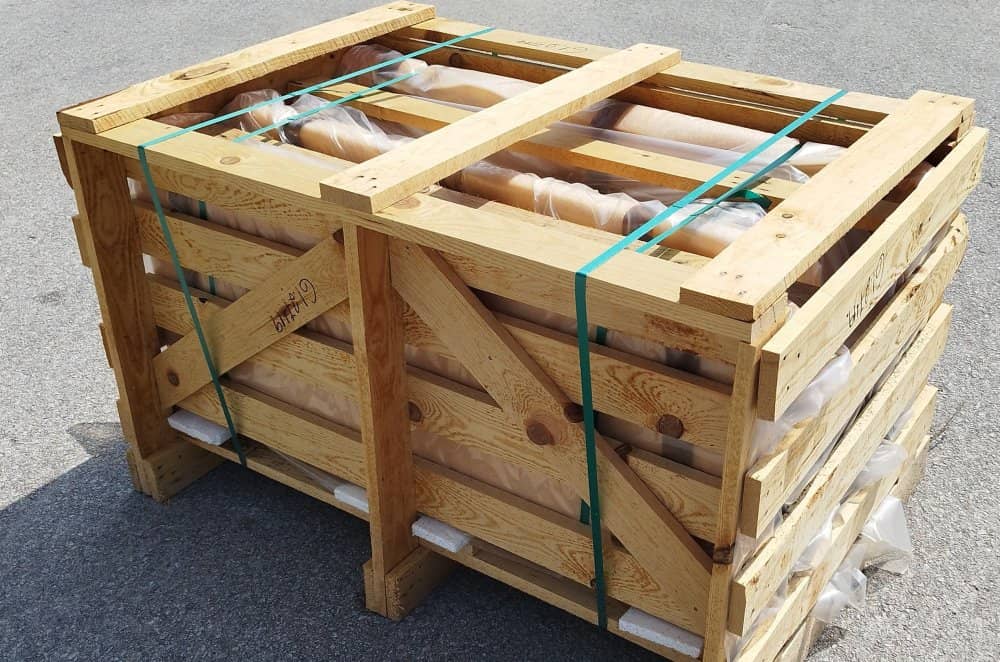
Logistics preparation is adapted to the mode of transport and destination. For road transport, slabs are secured on metal trestles. When shipped by sea, they are packed in wooden structures and loaded into containers, ensuring protection and stability throughout the journey.
Stone slab production is therefore much more than an intermediate production stage. It is a complete industrial process in which precision, production capacity, and quality control converge to create a versatile product, ready to meet both internal fabrication requirements and the demands of the global market.